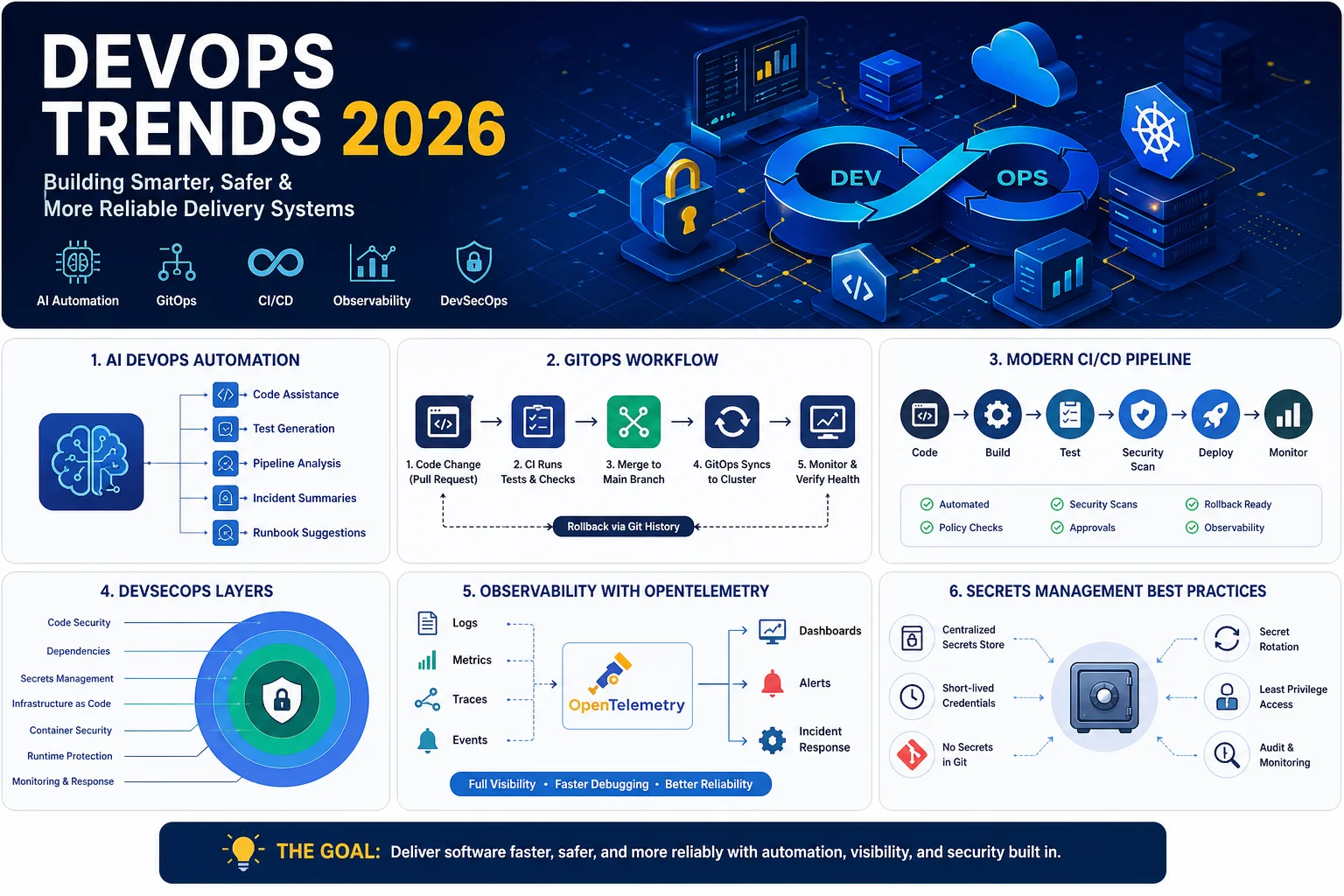
DevOps in 2026 is about fast delivery with safe releases, security by default, full observability and cost control. This guide covers the 12 trends that matter, the tools for each one, and what to adopt this week.
DevOps Trends 2026: Tools, Best Practices, and What to Adopt Now
Last updated: Feb 2026 This guide has been refreshed for 2026 with updated trends, tools, and practical adoption steps including Platform Engineering, GitOps and progressive delivery, supply chain security (SBOM + signing), OpenTelemetry observability, FinOps, and AI-assisted operations.
DevOps in 2026: What's Changed and Why It Matters
DevOps in 2026 isn't just "CI/CD + Docker." It's about fast delivery with safe releases, security by default, full observability, and cost control.
The teams doing DevOps well don't just deploy code. They build a system where shipping is predictable, incidents are diagnosable, and rollbacks are easy.
12 DevOps Trends to Watch in 2026
Use this format for each trend: Why it matters Tools Adopt this week
1) Platform Engineering and Internal Developer Platforms (IDPs)
Why it matters: Teams are reducing developer friction with self-service platforms and "golden paths" that standardize how services are created, deployed, and monitored. Tools: Backstage, Crossplane, Terraform Cloud/Enterprise, Internal portals, Service templates Adopt this week:
- Create a standard service template (repo + CI + deploy)
- Add built-in logging/metrics/tracing defaults
- Publish a "golden path" for new services
2) GitOps as the Default Deployment Model
Why it matters: Git becomes the source of truth for environments, reducing config drift and making deployments auditable. Tools: Argo CD, Flux, Helm, Kustomize Adopt this week:
- Move env configs to Git (dev/stage/prod)
- Deploy via PR approvals
- Document rollback using git revert
3) Progressive Delivery (Canary, Blue/Green, Feature Flags)
Why it matters: Safer releases with controlled rollouts and instant rollback reduce outages and stress. Tools: Argo Rollouts, Flagger, LaunchDarkly, Unleash Adopt this week:
- Add health-based rollback checks
- Use feature flags for risky features
- Canary 5% 25% 100% rollout strategy
4) Supply Chain Security (SBOM, SLSA, Signing)
Why it matters: Attacks increasingly target dependencies and pipelines, not just your app code. Tools: Syft, Trivy, Grype, Cosign, SLSA framework Adopt this week:
- Generate SBOM for each build
- Scan dependencies and fail builds on critical CVEs
- Sign container images and verify at deploy time
5) OpenTelemetry as the Observability Standard
Why it matters: Traces are critical in microservices. OpenTelemetry makes data consistent across tools. Tools: OpenTelemetry, Grafana Tempo, Jaeger, Prometheus, Loki Adopt this week:
- Instrument 1-2 key services with tracing
- Add correlation IDs (request IDs) everywhere
- Create a "slow request" trace dashboard
6) SRE Practices and SLO-Based Alerting
Why it matters: Alerting should reflect user impact, not noisy infrastructure events. Tools: SLO tooling, Prometheus alert rules, Grafana alerts, PagerDuty/Opsgenie Adopt this week:
- Define 1-2 SLOs (latency, error rate)
- Alert only on SLO burn rates
- Create a simple incident runbook
7) FinOps for Cost Governance and Efficiency
Why it matters: Cloud costs can grow faster than revenue if nobody owns them. Tools: Kubecost, AWS Cost Explorer, GCP Billing, Azure Cost Management Adopt this week:
- Track cost per service/team
- Identify top 3 waste areas (idle resources, storage, overprovisioning)
- Set budgets + alerts
8) Policy as Code (Compliance Built-In)
Why it matters: Security and compliance rules must be enforced automatically, not remembered. Tools: OPA, Gatekeeper, Kyverno, Terraform policy tooling Adopt this week:
- Block privileged containers
- Enforce approved base images
- Require resource limits on workloads
9) Kubernetes Maturity (Security, Scaling, Multi-Cluster Reality)
Why it matters: Kubernetes is mature, but real stability comes from disciplined operations and standards. Tools: Kubernetes, Helm, Karpenter, Cluster autoscalers Adopt this week:
- Standardize Helm charts / Kustomize structure
- Enforce namespaces + RBAC correctly
- Add autoscaling with safe limits
10) Secrets Management and Zero Trust by Default
Why it matters: Leaked secrets are still one of the easiest ways to get breached. Tools: HashiCorp Vault, AWS Secrets Manager, GCP Secret Manager, SOPS Adopt this week:
- Remove plaintext secrets from repos
- Rotate one high-risk secret now
- Add secret scanning to CI
11) AI-Assisted Operations (Noise Reduction, Incident Summaries)
Why it matters: AI can reduce alert fatigue and speed up investigations, if your telemetry is clean. Tools: AI incident assistants, log clustering, alert dedupe tooling Adopt this week:
- Deduplicate alerts by root cause
- Auto-generate incident summaries (template)
- Use AI for "first-pass triage," not final decisions
12) Developer Experience (DX) as a Competitive Advantage
Why it matters: Faster onboarding and simpler workflows mean faster shipping and fewer errors. Tools: Dev portals, documentation hubs, templates, local dev tooling Adopt this week:
- Write a "new service in 30 minutes" guide
- Standardize local dev setup
- Provide ready-to-use CI/CD templates
What to Adopt Now (Quick Checklist)
- GitOps + PR-based deployments
- OpenTelemetry tracing (at least critical paths)
- SBOM + dependency scanning + image signing
- Canary releases + automated rollback
- SLO-based alerting (reduce noise)
- Cost visibility (FinOps basics)
- Standard service templates / golden paths
Recommended Tool Stack for 2026 (By Category)
| Category | Recommended Tools |
|---|---|
| CI/CD | GitHub Actions, GitLab CI, Jenkins (if you must) |
| GitOps | Argo CD, Flux |
| Progressive Delivery | Argo Rollouts, Flagger, Feature Flags (LaunchDarkly/Unleash) |
| Observability | OpenTelemetry, Prometheus, Grafana, Loki, Tempo/Jaeger |
| Security | Trivy, Syft/Grype, Cosign, SAST/DAST tools |
| IaC | Terraform, Pulumi |
| Cost (FinOps) | Kubecost, Cloud billing tools |
Conclusion
DevOps in 2026 is about building delivery systems that are fast, secure, observable, recoverable, and cost-aware. If you can ship confidently, detect issues quickly, and roll back safely, you're ahead of most teams.