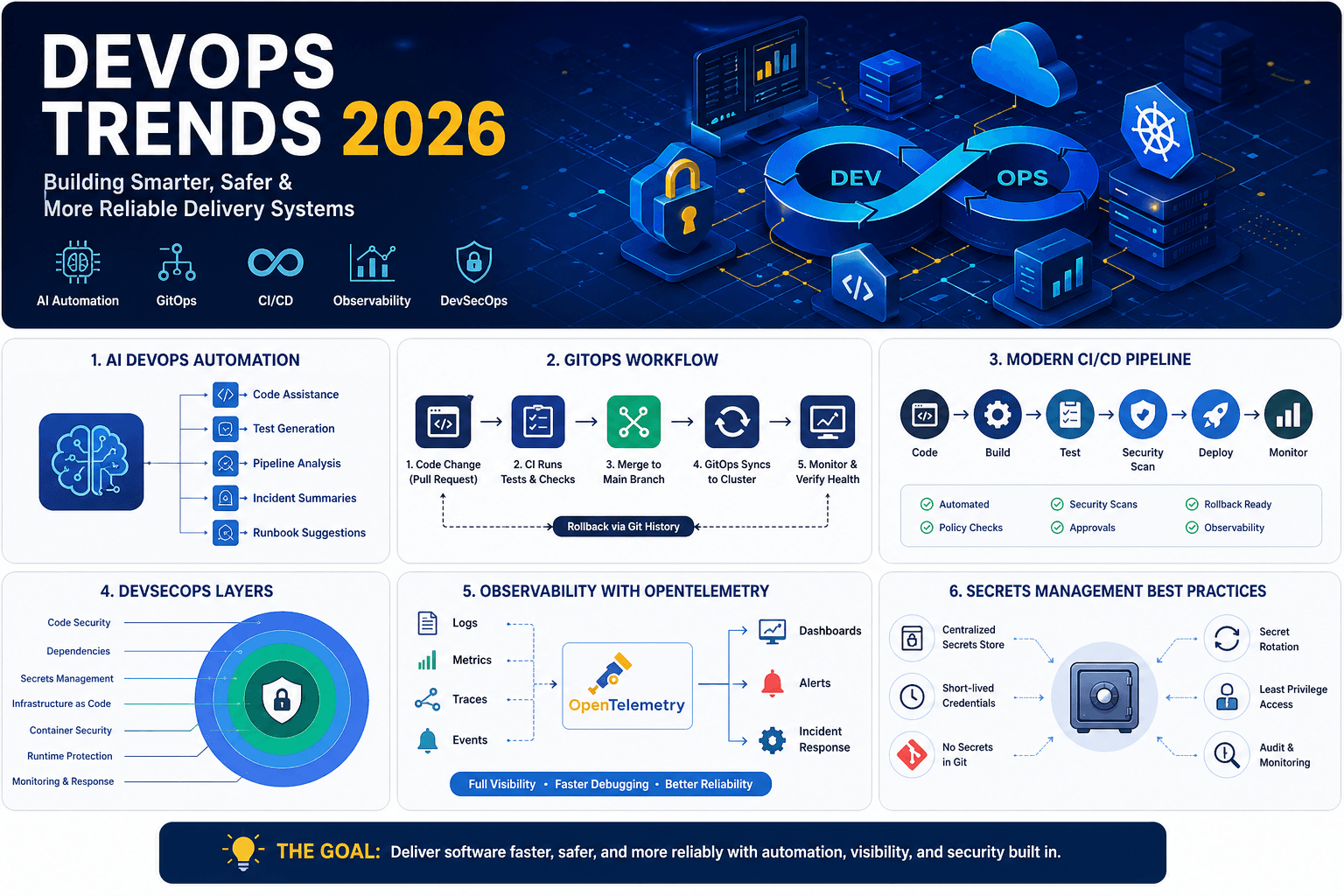
DevOps Trends 2026: Tools, Best Practices, and What to Adopt Now
Last updated: Feb 2026
This guide has been refreshed for 2026 with updated trends, tools, and practical adoption steps including Platform Engineering, GitOps and progressive delivery, supply chain security (SBOM + signing), OpenTelemetry observability, FinOps, and AI-assisted operations.
DevOps in 2026: What’s Changed and Why It Matters
DevOps in 2026 isn’t just “CI/CD + Docker.” It’s about fast delivery with safe releases, security by default, full observability, and cost control.
The teams doing DevOps well don’t just deploy code. They build a system where shipping is predictable, incidents are diagnosable, and rollbacks are easy.
12 DevOps Trends to Watch in 2026
Use this format for each trend: Why it matters → Tools → Adopt this week
1) Platform Engineering and Internal Developer Platforms (IDPs)
Why it matters: Teams are reducing developer friction with self-service platforms and “golden paths” that standardize how services are created, deployed, and monitored.
Tools: Backstage, Crossplane, Terraform Cloud/Enterprise, Internal portals, Service templates
Adopt this week:
- Create a standard service template (repo + CI + deploy)
- Add built-in logging/metrics/tracing defaults
- Publish a “golden path” for new services
2) GitOps as the Default Deployment Model
Why it matters: Git becomes the source of truth for environments, reducing config drift and making deployments auditable.
Tools: Argo CD, Flux, Helm, Kustomize
Adopt this week:
- Move env configs to Git (dev/stage/prod)
- Deploy via PR approvals
- Document rollback using git revert
3) Progressive Delivery (Canary, Blue/Green, Feature Flags)
Why it matters: Safer releases with controlled rollouts and instant rollback reduce outages and stress.
Tools: Argo Rollouts, Flagger, LaunchDarkly, Unleash
Adopt this week:
- Add health-based rollback checks
- Use feature flags for risky features
- Canary 5% → 25% → 100% rollout strategy
4) Supply Chain Security (SBOM, SLSA, Signing)
Why it matters: Attacks increasingly target dependencies and pipelines, not just your app code.
Tools: Syft, Trivy, Grype, Cosign, SLSA framework
Adopt this week:
- Generate SBOM for each build
- Scan dependencies and fail builds on critical CVEs
- Sign container images and verify at deploy time
5) OpenTelemetry as the Observability Standard
Why it matters: Traces are critical in microservices. OpenTelemetry makes data consistent across tools.
Tools: OpenTelemetry, Grafana Tempo, Jaeger, Prometheus, Loki
Adopt this week:
- Instrument 1–2 key services with tracing
- Add correlation IDs (request IDs) everywhere
- Create a “slow request” trace dashboard
6) SRE Practices and SLO-Based Alerting
Why it matters: Alerting should reflect user impact, not noisy infrastructure events.
Tools: SLO tooling, Prometheus alert rules, Grafana alerts, PagerDuty/Opsgenie
Adopt this week:
- Define 1–2 SLOs (latency, error rate)
- Alert only on SLO burn rates
- Create a simple incident runbook
7) FinOps for Cost Governance and Efficiency
Why it matters: Cloud costs can grow faster than revenue if nobody owns them.
Tools: Kubecost, AWS Cost Explorer, GCP Billing, Azure Cost Management
Adopt this week:
- Track cost per service/team
- Identify top 3 waste areas (idle resources, storage, overprovisioning)
- Set budgets + alerts
8) Policy as Code (Compliance Built-In)
Why it matters: Security and compliance rules must be enforced automatically, not remembered.
Tools: OPA, Gatekeeper, Kyverno, Terraform policy tooling
Adopt this week:
- Block privileged containers
- Enforce approved base images
- Require resource limits on workloads
9) Kubernetes Maturity (Security, Scaling, Multi-Cluster Reality)
Why it matters: Kubernetes is mature, but real stability comes from disciplined operations and standards.
Tools: Kubernetes, Helm, Karpenter, Cluster autoscalers
Adopt this week:
- Standardize Helm charts / Kustomize structure
- Enforce namespaces + RBAC correctly
- Add autoscaling with safe limits
10) Secrets Management and Zero Trust by Default
Why it matters: Leaked secrets are still one of the easiest ways to get breached.
Tools: HashiCorp Vault, AWS Secrets Manager, GCP Secret Manager, SOPS
Adopt this week:
- Remove plaintext secrets from repos
- Rotate one high-risk secret now
- Add secret scanning to CI
11) AI-Assisted Operations (Noise Reduction, Incident Summaries)
Why it matters: AI can reduce alert fatigue and speed up investigations, if your telemetry is clean.
Tools: AI incident assistants, log clustering, alert dedupe tooling
Adopt this week:
- Deduplicate alerts by root cause
- Auto-generate incident summaries (template)
- Use AI for “first-pass triage,” not final decisions
12) Developer Experience (DX) as a Competitive Advantage
Why it matters: Faster onboarding and simpler workflows mean faster shipping and fewer errors.
Tools: Dev portals, documentation hubs, templates, local dev tooling
Adopt this week:
- Write a “new service in 30 minutes” guide
- Standardize local dev setup
- Provide ready-to-use CI/CD templates
What to Adopt Now (Quick Checklist)
- GitOps + PR-based deployments
- OpenTelemetry tracing (at least critical paths)
- SBOM + dependency scanning + image signing
- Canary releases + automated rollback
- SLO-based alerting (reduce noise)
- Cost visibility (FinOps basics)
- Standard service templates / golden paths
Recommended Tool Stack for 2026 (By Category)
| Category | Recommended Tools |
|---|---|
| CI/CD | GitHub Actions, GitLab CI, Jenkins (if you must) |
| GitOps | Argo CD, Flux |
| Progressive Delivery | Argo Rollouts, Flagger, Feature Flags (LaunchDarkly/Unleash) |
| Observability | OpenTelemetry, Prometheus, Grafana, Loki, Tempo/Jaeger |
| Security | Trivy, Syft/Grype, Cosign, SAST/DAST tools |
| IaC | Terraform, Pulumi |
| Cost (FinOps) | Kubecost, Cloud billing tools |
Conclusion
DevOps in 2026 is about building delivery systems that are fast, secure, observable, recoverable, and cost-aware.
If you can ship confidently, detect issues quickly, and roll back safely, you’re ahead of most teams.